One of the most common — and least understood — challenges in any enclosed space is thermal stratification: the tendency of warm and cool air to separate into distinct layers. In Jamaica, where air conditioning is often essential for comfort, this phenomenon leads to wasted energy, uneven temperatures, and higher utility bills. The Exhale Gen-5, distributed in Jamaica by SMIA-RCCS Limited, is specifically designed to solve this problem through a process called air destratification. This article explains what that means and why it matters for your home, office, or commercial property.
1. Fluid Mechanics and How Air Behaves
Warm air is lighter than cool air. In any closed or poorly ventilated space, warm air naturally rises to the ceiling while cooler air remains near the floor. In rooms with high ceilings — such as hotel lobbies, churches, warehouses, or open-plan offices — the temperature difference between floor and ceiling can reach as much as 10 degrees Celsius, increasing by approximately 1.5 degrees Celsius for every metre of height above four metres.
This natural layering of air at different temperatures is known as thermal stratification. It produces three key problems:
- Significant energy loss, as the space must be over-cooled or over-heated at floor level to compensate for the warmth trapped at ceiling level.
- Wasted money, spent cooling or heating areas of the room where no one benefits.
- Poor environmental management, resulting in an unnecessarily high carbon footprint.
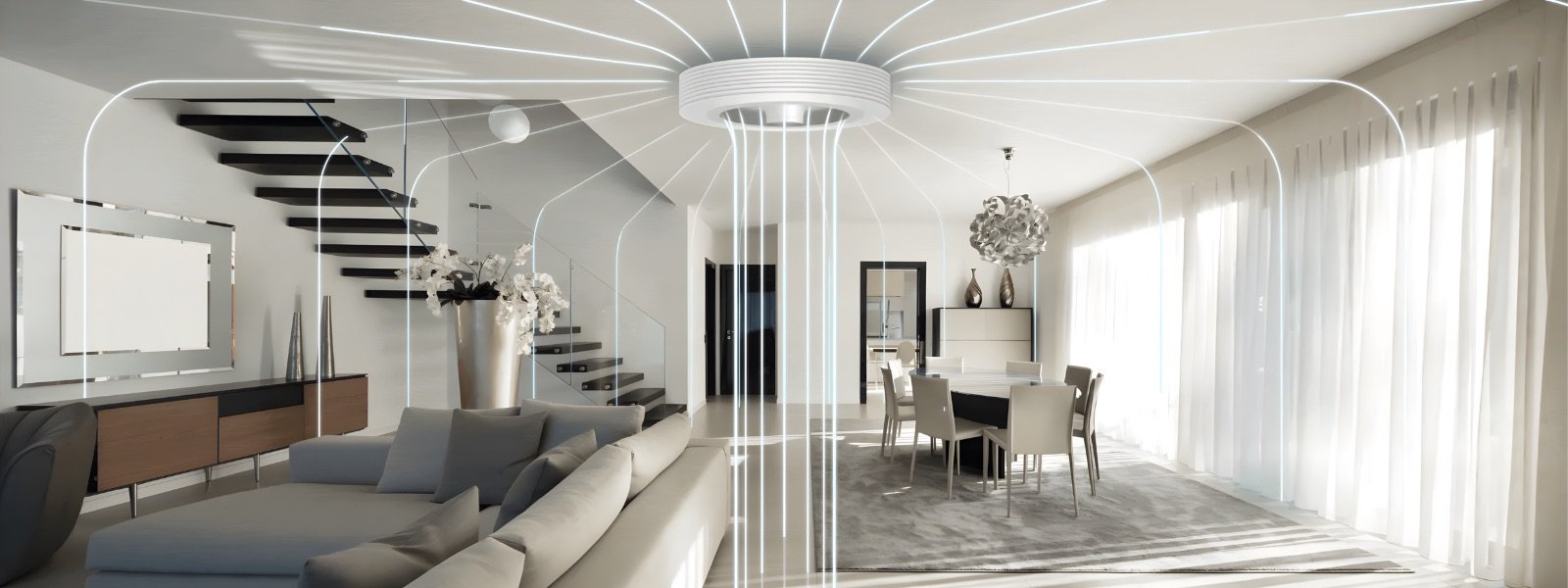
To address this, the Exhale Gen-5 uses its patented laminar flow technology to continuously circulate air — moving warm air downward and drawing cooler air upward in a seamless, room-wide cycle.
2. Functional Characteristics of the Exhale Gen-5 as a Destratification Fan
There are four key parameters to consider when evaluating a destratification solution.
Treated Air Flow Rate: The volume of air circulated per hour. The higher the flow rate, the more effective the destratification.
Ambient Air Circulation Rate: The efficiency of air mixing, calculated as the ratio of air flow rate to the volume of the space. A ratio of approximately 3 is considered effective air mixing.
Noise Level: Most destratification fans operate between 45 and 60 decibels. The Exhale Gen-5, by contrast, operates between 35 decibels (Speed 1) and 40 decibels (Speed 6), making it among the quietest available — ideal for Jamaican homes, offices, schools, and hospitality spaces.
Energy Consumption: Running the Exhale Gen-5 at Speed 1 (35 decibels, just 4 Watts) continuously for a full month costs approximately JMD $160 in electricity at prevailing Jamaican rates — a negligible amount compared to the cooling savings it generates.
3. The Practical Effects of Destratification
Using the Exhale Gen-5 for air destratification creates a consistent temperature throughout the room by continuously and gently mixing the ambient air. This eliminates hot spots near the ceiling and cool spots at floor level, improving comfort for everyone in the space. Over time, this consistent air mixing also helps reduce excess humidity — a particular benefit in Jamaica’s tropical climate, where moisture accumulation is a constant challenge.
4. The Benefits of Destratification
- Financial savings of up to 30% on cooling costs, depending on ceiling height, occupancy, and local climate conditions.
- Energy savings by limiting unnecessary over-cooling and reducing the workload on air conditioning systems.
- Environmental benefit — a potential 30% reduction in cooling-related energy emissions.
- Dehumidification benefits, as improved air circulation helps prevent moisture pockets from forming — reducing the risk of mold and mildew in Jamaica’s humid environment.
- Better quality of life: consistent temperature distribution significantly improves comfort for all occupants of the space.